
Your Service and Location Pages Are Why Google Ignores You
By S4 Connect • September 23, 2026
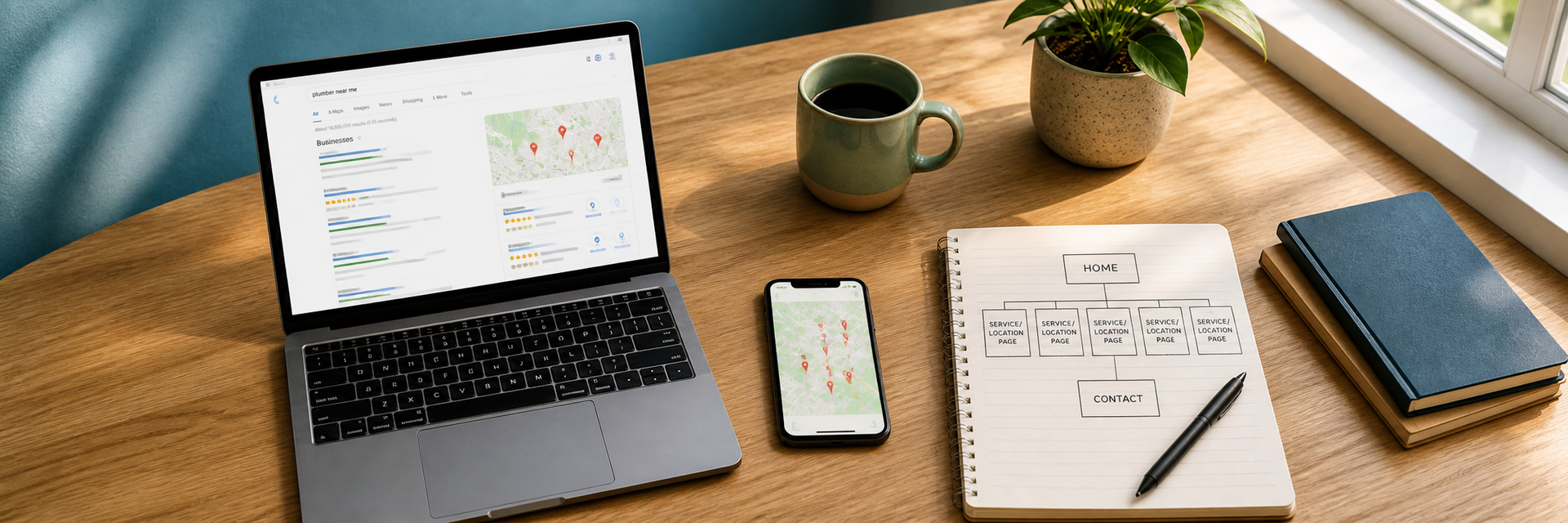
Your Service and Location Pages Are Why Google Ignores You
If your business serves a specific area and you're not showing up when people search for what you do, the answer is probably simpler than you think. It's not your domain authority. It's not your backlinks. It's your service and location pages.
Most local business websites treat these pages like an afterthought. A heading, maybe a sentence or two, a phone number, and a link to pricing. That's it. And that's exactly why Google skips right over them.
What Google Sees When It Looks at a Thin Page
Google's job is to match a searcher with the most useful result. When someone types "oil change near me" or "pizza delivery in Clawson," Google is scanning pages for relevance, depth, and local signals. A page with a heading that says "Oil Changes" and nothing else doesn't give the algorithm anything to work with. There's no context, no location signal, and no reason for Google to believe your page answers the question better than the hundreds of other thin pages out there.
The data backs this up. According to a 2026 analysis of over 50,000 ranking pages, the median word count of a page in the number-one spot on Google is over 1,800 words, and even pages at position ten come in above 1,100. You don't need to hit those numbers for every local search term, but you need to be in the conversation. Pages under 300 words rarely are.
The Fix Is the Cheapest One in Local Search
Here's the good news: fixing this doesn't require a redesign, a new platform, or a five-figure budget. It requires content.
Pages that rank well for local search terms typically have 500 to 1,000 words of genuinely useful information with the city or service area name worked in naturally - not stuffed in every other sentence. Just present the way a real person would describe what they do and where they do it.
That means your "Brake Repair" page shouldn't just say you offer brake repair. It should explain what a brake inspection includes, when someone should get their brakes checked, what to listen for, and why your shop in [city name] is equipped to handle it. That's the kind of page that earns a click from Google, because it actually answers the question someone asked.
What This Looks Like for a QSR Location Page
If you run a pizza franchise with six locations, you probably have six location pages that are nearly identical. Name, address, hours, maybe a map embed. That checks the "we have a page" box, but it doesn't do anything for search.
A location page that performs has personality. It mentions the neighborhood, the nearest landmarks, what makes that store different. "Our Westland location off Ford Road" tells Google something. "Location #4" does not.
Each location page should include:
- The full address and service area, written out naturally in a sentence or two
- A paragraph about the neighborhood or community the store serves
- The menu or services available at that specific location (even if it's mostly the same, the page copy shouldn't be copy-pasted)
- Hours and ordering info with location-specific calls to action
This is how one location starts ranking for "best pizza in Westland" while the other five sit invisible. Same brand, same food, different page quality.
What This Looks Like for a Dealership Service Page
Dealership websites are some of the worst offenders. Sales inventory pages get all the attention. The service department? A "Tire Rotation" page with one line of text and a "Schedule Service" button. That's not going to rank for anything.
But a page that explains what a tire rotation involves, how often it should be done, what it costs, and why your certified techs in [city] are the right choice? That page competes. The opportunity is wide open because almost nobody in the dealership space is doing this well. The one that writes real content for each service page starts pulling organic traffic away from the independents and chains that dominate those searches today.
What This Looks Like for a Landscaping Company
Landscaping is one of the most search-driven local industries, and the websites are almost universally terrible. Most have a single "Services" page that lists lawn care, hardscaping, irrigation, and seasonal cleanups in a bulleted list with no detail. That page is competing against every other landscaper in the metro with the exact same layout.
The fix: break each service into its own page. A dedicated "Paver Patio Installation in [City]" page that explains the process, the materials you use, how long a typical project takes, and what it costs gives Google something to actually index. Someone searching "patio installers near me" is going to land on the company that answered their question, not the one that buried "hardscaping" in a bullet point.
Landscapers also have a built-in geographic advantage most don't use. If you serve five towns, you should have location-specific content for each one. "Lawn care in Plymouth" and "lawn care in Northville" are different searches with different competitors. One page trying to cover your entire service area loses to a competitor who wrote a page for each city.
How to Prioritize This
You don't have to rewrite your entire site in a weekend. Start with the pages tied to your highest-value services or locations, the ones where ranking would actually move the needle on revenue.
- Pick your top three to five service or location pages. Choose the ones tied to the services you want to be found for or the locations with the most competition.
- Write 500 to 1,000 words of real, useful content for each one. Answer the questions a customer would actually ask. Include the city or area name where it fits naturally.
- Add internal links. Link from your service pages to related content on your site (your blog, your contact page, your Google reviews). This helps Google understand how your site connects.
- Update your meta titles and descriptions. Make sure each page's title tag includes the service and the city. "Brake Repair in Ann Arbor | [Dealership Name]" beats "Services" every time.
- Repeat for the next batch. Once the first round is indexed and you're seeing movement, expand to the rest.
For most businesses, the first round of updated pages can be live within a couple of weeks and showing results within 60 to 90 days.
The Bottom Line
If your pages don't give Google a reason to recommend you, it won't. The fix is straightforward, it's affordable, and it works. Start with the pages that matter most and build from there. If writing this kind of content sounds like more than your team can take on, S4 Connect can help.
Your competitors are spending money on ads to show up in search results. You can show up organically by writing better pages. Service and location pages are the lowest-hanging fruit in local SEO, and most local businesses are leaving them completely bare.
Sources
- Visionary Marketing, "SEO Statistics 2026: 50,000-Page SERP Correlation Analysis," Q1 2026. Analyzed median word count by SERP position across 2,400+ queries and 24 verticals.
Growth Starts Here
Strategy, creative, and media under one roof. Let's build something that works.
Insights to fuel your marketing business
Marketing tips, trends worth knowing, and a few strong opinions. Once a month, straight to your inbox.
Contact Us
All set! Great marketing insights are headed your way.
Please try again later.
By subscribing, you agree to receive marketing emails from S4 Connect. Unsubscribe anytime.
View our
Privacy Policy
SHARE THIS